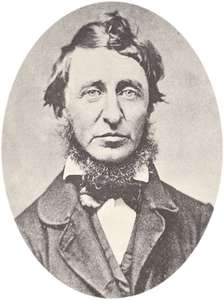
Henry David Thoreau: Nature’s Friend
Henry David Thoreau: Nature’s Friend
Henry David Thoreau was born July 12, 1817, in Concord, Massachusetts where he spent most of his life and was educated at Harvard University. But he was no lover of town life and the mundane, more trivial things pertaining to man. He was a very deeply spiritual person who had a deep love for and a connection to nature, and he subscribed to Transcendentalist thought. Transcendentalist thought is a philosophy in which he believed that spirit is greater than matter and intuitive thought more insightful than mere reasoning. In short, this man had the mind of a poet, and the story has it that he bristled so much at the status-qua that he insisted on wearing a green jacket to chapel as a young student when the rules of the school called for black.
But no discussion of Thoreau is complete without touching on Thoreau’s close friendship with Ralph Waldo Emerson, one of the foremost writers and transcendentalists of the day. Emerson was a man who staunchly believed in the value of the individual over the group and the importance of the ability of man to live independently and free from having overmuch reliance on others. Thus Emerson became a close mentor to Thoreau and provided the parcel of land where Thoreau built his tiny cabin on Walden Pond to launch his own experiment in independent living by living off the land, connecting with nature, and to write his most famous book, Walden. So there on Walden pond, he lived alone for the span of two years,
Walden is a book about his adventure in the wilderness and is a vivid description of the natural world there throughout the four seasons and embodies the many-core Transcendentalist philosophies such as the importance of living a simple life, with few expenses, as the way to true independence and joy. He was a minimalist whose three most famous words “Simplify!” “Simplify!” “Simplify!” really resonate with my spirit today. Thoreau hated the technology that encroached upon nature especially the railroad and commercial farming, but always believed that nature would ultimately triumph as expressed in the following poem: