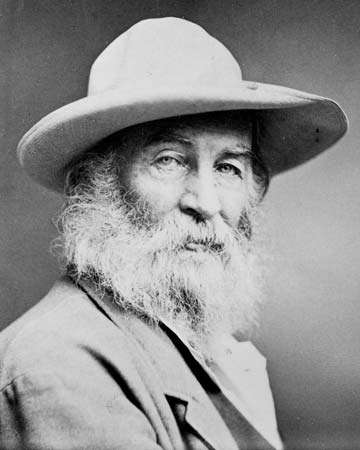
Walt Whitman: The Great American Bard
Walt Whitman: The Great American Bard
Walt Whitman was an innovative poet who went down in history as America’s most influential bard because of his unprecedented experimentation with free-verse poetry. He was born on May 31, 1819, to a farming family that was failing financially, so his father had to move the family of 9 children from his rural birthplace in West Hill, New York to Brooklyn where his father became a carpenter. Whitman attended public school there, but because his impoverished family still struggled, Whitman, unfortunately, had to drop out of school at age twelve and go to work in order to help them. He became a printer’s apprentice, however, he liked to read and continued to educate himself in New York’s public libraries.
He was eventually promoted from printer to journalist and then to the editor of one of New York’s major newspapers, but he was fired because of his antislavery views. During this self-education period of his life, Whitman began to experiment writing poetry in free-verse form using the very hypnotic cadences found in the Bible and was very much like Hebrew poetry found in the Old Testament. Much of it did not rhyme making it a revolutionary form on the current day’s literary landscape. So when the first edition of his book Leaves of Grass was anonymously self-published in 1855 it was mostly written off by the establishment as “garbage” except for Ralph Waldo Emerson who said the book was full of “wit and wisdom”. And Whitman wrote three more revised editions over his lifetime.
During the Civil War Whitman was one of America’s greatest patriots and was a staunch abolitionist so he wrote his poem Beat! Beat! Drums as a call for the people to rally and fight to keep America one nation. He did not want the people to rest and become complacent with their everyday lives.
“Beat! Beat! Drums! -blow bugles blow!
Over the traffic of cities- over the rumble of
wheels in the streets:
Are beds prepared for sleepers at night in the
houses? No sleepers must sleep in those beds…”
So when Whitman got word that his own brother had been wounded in the war, he traveled to the South to find him and was so moved by seeing the carnage of the war that he moved to Washington DC to become a volunteer nurse in the army hospitals there and served to comfort both the wounded Confederate and Union soldiers suffering there. Whitman was a man of great compassion and love and he wrote my all-time favorite American poem O’ Captain My Captain as a heartfelt tribute to President Abraham Lincoln after his assassination.