Sonnets Are the ‘Little Songs’ of Wise Poets
Form. Form. Form. Form is what the sonnet is all about. All types of sonnets are written by the same basic rules of being a total of fourteen lines written according to a strict rhyme scheme and meter of certain common patterns employed at discretion of the poet. And most often iambic pentameter, a meter of ten syllables per line with a strong syllable being followed by a weak one, is used in the English speaking world.
The sonnet itself had it’s beginning in Italy and was the invention of Giacomo da Lentini who served as a poet in the court of Fredrick the II, the Emperor of the Holy Roman Empire in 13th century Sicily. The early sonnets always presented a problem or a perplexing situation at the beginning and ending with a solution or a wise reflection on the problem. And classically the problem involved the love for a dispassionate beautiful woman and a broken-heart-ed suitor. But as time went on, and the form evolved, these sonnets also included a more realistic woman and and were written on a variety of subjects by the time of Shakespeare.
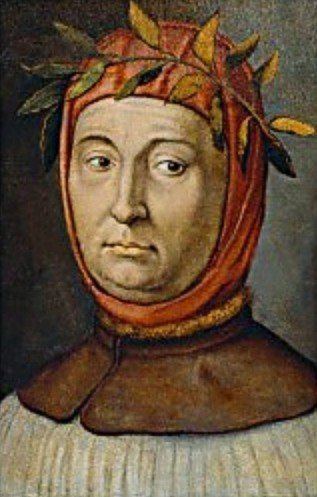
In the English tradition there are three main types of sonnets: the Italian (Petrarch-an) sonnet, the Spenserian sonnet and the Shakespearean sonnet, The Italian sonnet is characterized by an octave of eight lines with an ABBAABBA rhyme scheme and a sextet with a with either a CDECDE or a CDCDCD rhyming pattern as seen in this example by Milton:
When I consider how my light is spent,
Ere half my days in this dark world and wide,
And that one talent which is death to hide
Lodged with me useless, though my soul more bent
To serve therewith my Maker, and present
My true account, lest He returning chide;
“Doth God exact day labor, light denied?”
I fondly ask, But Patience, to prevent
That murmur, soon replies, “God doth not need
Either man’s work or His own gifts. Who best
Bear His mild yoke, they serve Him best, His state
Is kingly: thousands at His bidding speed,
And post o’er land and ocean without rest;
They also serve who only stand and wait.
The Shakespearean sonnet is written in three quatrains of four lines each and ends in a couplet with a rhyme scheme of ABAB CDCD EFEF GG as in this example:
Two households, both alike in dignity,
In fair Verona, where we lay our scene,
From ancient grudge break to new mutiny,
Where civil blood blood makes civil hands unclean.
From forth the fatal loins of these two foes
A pair of star-cross’d lovers take their life;
Whose misadventured piteous overthrows
Do their death bury their parents’ strife,
The fearful passage of their death-mark’d love,
And the continuance of their parents’ rage,
Which, but their children’s end, nought remove,
Is now the two hours’ traffic of our stage;
The which if you with patient ears attend,
What here shall miss, our toil shall strive to mend.
The Spenserian sonnet is a very complex form with the interlocking rhyme scheme of ABAB BCBC CDCD EE making the poem a tight unified ,
little unit, and although these poems are relatively short, they are in really huge masterpieces in form.
One day I wrote her name upon the strand,
But came the waves and washed it away:
Again I write it with a second hand,
But came the tide, and made my pains his prey.
Vain man, said she, that doest in vain assay,
A mortal thing so to immortalize,
For I myself shall like this decay,
and eek my name be wiped out likewise.
Not so, (quod I} let baser things devise
To die in dust, but you shall live by fame:
My verse, your virtues rare shall eternize,
And in the heavens write your glorious name.
Where when as death shall all the world subdue,
Our love shall live, and later life renew.
…………………………..
This is first a three part series on this most historically important form of poetry which will include an article about the works of contemporary writers and the life and works of Elizabeth Browning, a lady master of the sonnet. Contemporary poets vary both the rhyme schemes and meters of the seemingly “simple” sonnet.