
by: Shirley Satterfield
Emily Dickenson: The Secret Poet
Emily Dickinson: The Great American Lady Bard
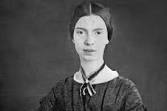
Emily Dickinson was the mysterious recluse poet who, although her friends and neighbors deemed her to be an exceedingly eccentric spinster as she grew older and older, so when they saw her moving about alone in her garden wearing her customary ghost-like white attire (McMichael pg.8), they missed the real poetic genius blossoming right under their noses, but however eccentric and solitary she seemed to be, she was actually a passionate woman who knew how to love a man. Howbeit the man she to whom she directed her love was a forbidden fruit for her, a married man with a family and a minister of the Gospel of the strictest of Puritan persuasions.
Born May 30, 1830 in Amherst, Massachusetts to a politically prominent family, with her father being a U.S. Congressman, she never traveled much farther from her childhood home than nearby Boston. She attended Amherst Academy as a young woman, the college which was founded by her own devoutly Christian grandfather, who was a man “that ruined himself for the materializing of his apocalyptic vision; the founding of Amherst College” (Bianchi and Hampson pg.v), and thusly she was an educated and talented woman, but she only published as few as eight of her vast collection of poems during her lifetime because in being such a private person, she never really wanted to be published and none that she wrote had titles but were each one given a Roman numeral number by her editors post posthumously (McMichael pg.9), and being so private this shy poet penned these words.
I’m nobody! Who are you?
Are you nobody, too?
Then there’s a pair of us-don’t tell.
They’d banish us, you know.
How dreary to be somebody!
How public like a frog
To tell your name the live long day
To an admiring bog!
Her natural humor which expresses her true sentiments and intellectual wit is self evident in this poem, and so it behooves all writers and poets of every ilk to examine the underlying motives of the “why” they want their words to be immortalized in print. Is it done for the art of it or a purpose greater than self, or is it just to being done to be “public like a frog,”? That is the question that every writer needs to examine.
Her great body of work of at least one thousand poems was not published until her death in 19..) when her sister L discovered them written on little bits paper stashed in Dickinson’s dusty attic among all her other old mementos of her earthly life and this great poet had written of her own inevitable death:
I died for beauty, but was scarce
Adjusted in the tomb
When one who died for truth was lain
In an adjoining room.
He questioned softly why I failed?
For beauty’ I replied.
“And I for truth—the two are one;
We brethren are,” he said.
And so, as kinsmen met
Until the moss had reached our lips,
And covered up our names
She also loved to write about nature and she had such an eye for detail that her own garden provided a whole world of color and inspiration, and her own personal modesty is expressed as she was moved to write:
Forever cherished be the tree,
Whose apple Winter warm,
Enticed to breakfast from the sky
Two Gabriels yestermorn;
They registered Nature’s book
As Robin – Sire and Son,
But angels have that modest way
To screen them from renoun.
She writes here as if nature itself was this lonely, solitary woman’s only best friends and it also seems as though she drew much of her spiritual strength and solace from this natural world just outside her door, although this shy woman herself was a rather otherworldly figure,
But alas, this great American Lady poet who died inside for beauty and although she was a nobody, was elevated by “Truth “ to become one of America’s foremost, famous bards.
1. Anthology of American Literature, Fifth Edition: p.8 and 9, George McMichael.
2. Poems by Emily Dickinson, p.v, edited by Martha Dickenson Bianchi and Alfred Leete Hampson.