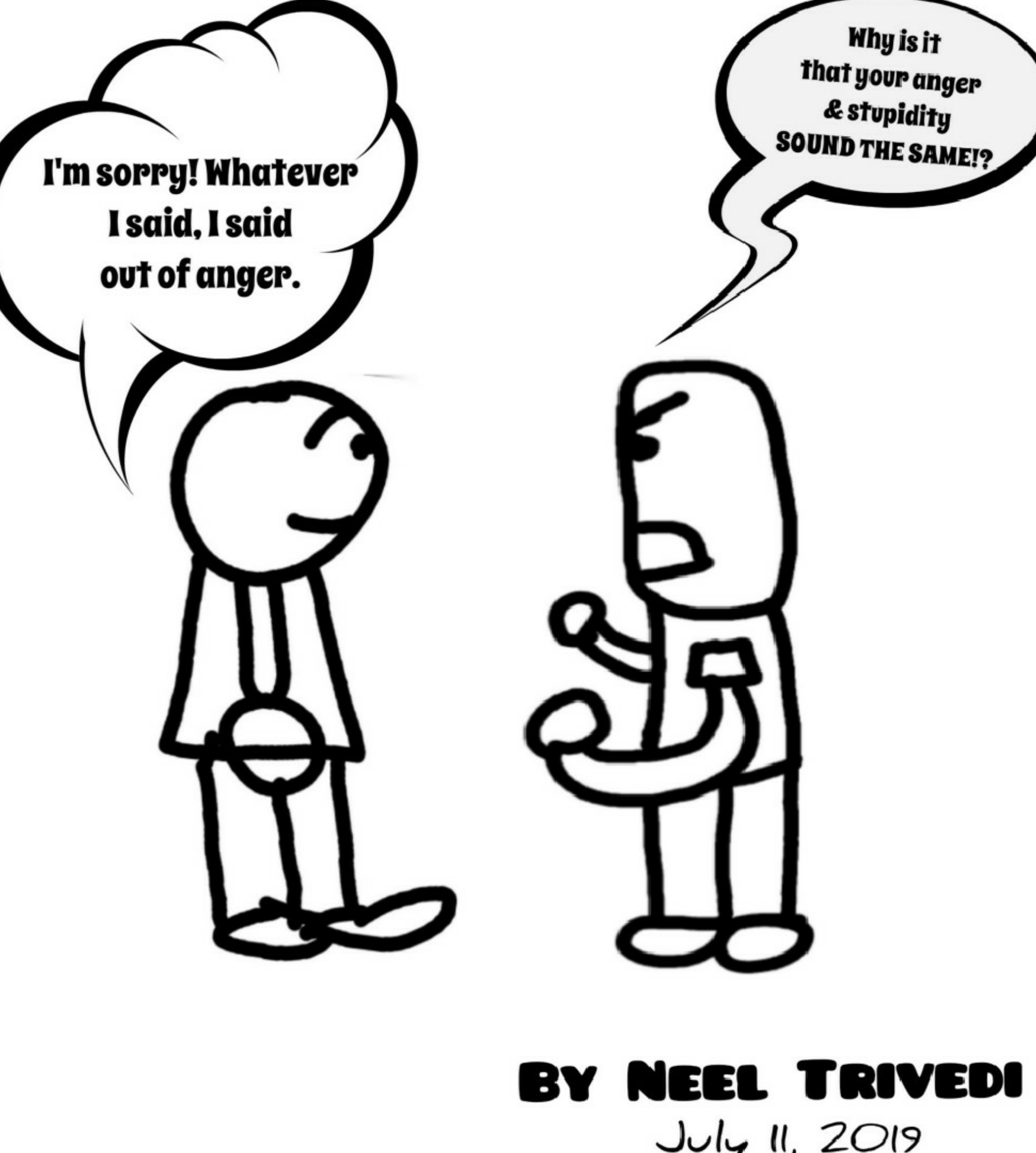
“Never argue with an idiot. People watching won’t be able to tell the difference.”
-Iliketoquote.com
Sometimes they help us. Other times they dominate our lives for long periods only to lead nowhere. I’m talking about arguments.
Daily Wisdom Words it is a writer's community
“Never argue with an idiot. People watching won’t be able to tell the difference.”
-Iliketoquote.com
Sometimes they help us. Other times they dominate our lives for long periods only to lead nowhere. I’m talking about arguments.
Strife is a feeling we have surface when we have not communicated clearly to begin with another person. Strife tends to build over time. Sometimes, when two people hold opposite opinions, strife can simply occur. There are ways to avoid strife but the main way to dodge this bullet is to communicate better and respect other’s thinking and opinions. Before going any further, we will look at the definition in the Webster Dictionary and DWW definition of strife.
Webster Definition of Strife-1. Angry or bitter disagreement over issues; Conflict.
DWW definition of Strife-Communication and mutual respect for another’s opinion.
When we experience the feeling of strife towards another, chances are there has already been a breakdown in our communication with them. We see strife often in marriages when two people refuse to compromise with the other. There most likely is a discretion they simply can’t get past. Can Strife be resolved? I have found when things get to this point in any relationship, the best thing to do is scratch the past and start over new.
Too many harmful things have been said and done at this point to go further with what is “damaged goods”. Some of us believe there is no such thing as starting over once a relationship has reached feeling strife towards another. I, on the other hand, believe the initial love that started this relationship, to begin with, is still underneath strife. Both individuals in the relationship must believe this as well. They must be willing to put forth the extraordinary effort needed to change the dynamics in how they interact.
Yes, it is possible to fully change the dynamics in a relationship with unfathomable effort. Sometimes at this point, it is best to separate when strife stands between them. This is what I call “irreconcilable differences” and why many marriages end in divorce. Sadly, there is no coming back when you’ve reached this point.
Strife is so difficult in a marriage involving children. It must be said that at this point the best thing to do is put the children first and start over in a separate relationship where this is the top priority. Children are so impressionable and to see strife between their parents once they are apart is horribly difficult on them. The parents must realize they are setting cement examples of how impossible it can be to get along with others even civilly and they can potentially carry this with them for life acting out in their own relationships.
Thanks so much for reading about strife today. Although these feelings in any relationship are extremely negative, there is always a way back to peace even if it takes changing the form of the relationship completely.
Samantha Leboeuf/DWW
‘
Why do we have disagreements? At what point do they spin out of control and become arguments? Before we answer these questions, let’s take a look at the meaning of disagreements in our Webster Dictionary.
Disagreements-1. Lack of consensus or approval. 2. Lack of consistency or correspondence.
Daily Wisdom Words Definition of Disagreements-inability to reach a compromise or resolve issues peacefully.
Disagreements are the preliminary step before full blown arguments. Disagreements start when the kindness leaves the verbiage between two people who are having a dispute of some kind. Disagreements need to be stopped 99% of the time because it isn’t productive to take the conversation to the argument level. I want to talk about disagreements we have in our personal relationships. This seems to be where the majority of the problem where disagreements are used for power plays or some other reason that isn’t above board with integrity. Disagreements start when each party refuses to take responsibility for their emotions and truly feel they are in the right instead of taking responsibility for their feelings and emotions which is what adults do. To resolve a dispute the best thing one can do if the issue really is what is being portrayed on a surface level to the other party is to have Conversations like this which needs to be started by asking the other party for permission to speak.
Asking for permission to have productive dialogue is a great way to steer the conversation back to some form of normalcy. Once you have permission and the floor is yours, start the conversation by taking responsibility for your feelings. A great way to do this is to start your sentences off with these words: “I think”, “I feel”, “I chose to”. This takes the pressure off the other party to respond in a defensive manner, especially if you both have talked about how you will handle disagreements prior to having this one.
Healthy couples usually have a game plan they stick to and have discussed how they will deal with arguments when they have to. Disagreements don’t have to be non-productive. In fact, they can be healthy if disagreements follow the platform I have just gone over with from the beginning or start of the disagreement.
Once one party has spoken their peace, the other party in the disagreement should do the same, stating their feelings taking responsibility for those feelings when communicating those feelings on their end.
These are just a few constructive thoughts on dealing with disagreements and there are many more productive avenues to use to avoid the next step of a disagreement escalating into an argument. Thank you for reading about disagreements today. Have a beautiful and blessed day!!
When your finished reading this, scroll down beneath it to the “join the discussion box” and leave a comment on your thoughts about disagreements and what methods you’ve found productive to use when dealing with them. If you don’t wish to leave a comment, write a poem or a quote about disagreements in place of it.
Daily Wisdom Words is a full, interactive website with a lot of things to do on it. You can shop at our new online store, order a book review if your an author, take part in our daily picture prompts with Ace who provides a wonderful picture and two words to include in your poem which you will write in the join the discussion box beneath his posts, Neels Wisdomology, which is quotes he configures with advice of wisdom about daily things we go through and a poem to compliment his advice,, Shirley’s Wise Poets, Past and Present every Saturday which contains a fabulous article about a famous poet such as Walt Whitman, or Emily Dickinson or a current Poet who Shirley feels has a lot of talent we can all gain knowledge from. We offer a mini-facebook application for networking for Authors and Poets which works well in getting to know other members on our site, and finally, Peter’s Music Prompt. every Fri..Sat., amd Sunday where a popular song is played and you write a poem about your impression of the song. Daily Wisdom Words is an amazing website with so much to da, and joining is inexpensive and you sign up on our homepage. for $10 for a lifetime membership to utilize all of the above things to do. There are also Poetry Contests, and other events we offer on a regular basis to keep the website interactive and fun.
Samantha Leboeuf/DWW
“Speak when you are angry and you will make the best speech you will ever regret.”
-Ambrose Bierce
I’ve often felt that in this day and age, the proverb “silence is golden” is not very apt, especially in an age in which silence is often mistaken for contentment.
That said, I do think there is one time when it’s better to bite your tongue: when you’re angry.
First, we have to accept that anger is a natural emotion which cannot be avoided. So by no means am I advocating suppressing it (unless you have a serious medical problem with it).
What I am suggesting is to remain silent when angry.
For one thing, we should always be in control of our speech which is difficult to do in anger.
Secondly, I’ve always believed that while making an argument, there should be some rationale behind it (even if it’s one only you believe in) simply so you don’t come across as ignorant. That also is difficult to do in anger.
When you’re angry, it’s best to walk away and let it out in other ways (write about it, punch a pillow, etc).
Then come back and make your point afterward when you’ve had some time for more objectivity.
Do you have ways of dealing with speech while angry? Join the discussion and comment below.